
DISCOVERING SIGNIFICANCE IN SORROW

Mitchell’s casket had been removed and all that was left was his scooter, gently adorned with his little shoes, a bottle of water he loved to drink, and a few memorial gifts and flowers.  My cousin-in-law, a professional photographer, took this photo just after my family was escorted into the chapel where my tender-hearted wife and I would give the most painful address of our lives. 

My little boy’s journey through life and death has taught me to not ask why, but rather “What am I to learn?”  That, it seems, is the gateway to significance.  To think less about the why of things, and more about what they mean.
— Christopher M. Jones | Mitchell's Journey

The last thing on my mind was this scooter that was left behind – so, weeks later, when I stumbled into this photo, I wept.  Then, I caught my breath and wept some more.  Vacant and alone, this ordinary image of my son’s abandoned scooter stood as a stark reminder of what really matters in life.  This was a moment of significance for me.   

I remember kneeling at Mitchell’s bedside just a few days before he passed away.  I remember almost everything, in fact, with vivid clarity.  To carry such vivid memories has been both a blessing and a burden.  With great sorrow I watched my little baby made of sand slip through my fingers and into the abyss.  As I sat by my little boy, who was struggling to breathe, and I ran my fingers softly through his hair and tickled his arms as we just talked about stuff that was on his mind.  My sweet ten-year-old only wanted to run, play and be like all the other young children he knew.  At one point during our conversation at the side of his bed Mitch lamented, with great feeling, how much he wished he could be like “regular kids.”  My soul, already broken, broke some more.     

With tears in my eyes and love pouring out of my soul, I said, “Oh, little Mitch, you are so much more than a mere mortal.  If only you could see who you really are and what you may one day become.  Just remember: our bodies are temporary, our souls are forever.  You, my little boy, are so much more than you know.”  Mitch smiled softly, closed his tear-filled eyes and drifted to sleep.  I kissed his face and then prayed to my Father that my back might be strengthened so I could carry such a burden as grief.  How heavy it would soon become, I knew not.  Soon, my legs would buckle and my hands tremble from the weight of grief.  The hell I knew was just a foretaste of what was to come.

A few days later my little boy was gone and I journeyed through the deepest, darkest recesses of the soul.  All that I thought I knew of sorrow … all my mental and emotional preparations for his death failed me.  I thought I was prepared, but I was not.  The grief I felt prior to my son’s death was merely a whisper.  A faint shadow.  A feather … as compared to the heavy and harsh realities of death.  New to this form of grief, I had to remember what I told my son, “Our bodies are temporary, our souls are forever.”  Though I know that the soul lives on, that knowledge doesn’t take the sting of death away.  It provides context and meaning, but it offers no insulation from sorrow.   Though I have also experienced a comfort and peace that defies my human understanding, those moments of heavenly peace come and go just like the tides of grief.   

I’ve heard it said, “Those who mistake success for significance, will lead a deeply unfulfilled existence.”  

My little boy’s journey through life and death has taught me to not ask why, but rather “What am I to learn?”  That, it seems, is the gateway to significance.  To think less about the why of things, and more about what they mean.

HOSPITALS & COUNTRY CLUBS

Time was ticking.  We didn’t know when the biological bomb in my son’s chest would detonate.  We only knew the hour was late and there wasn’t much time left.  Would Mitchie’s heart stop on the drive home?  Or would we have a few precious days with him?  There was no way of knowing whether death would come suddenly or slowly … or whether it would be painful or peaceful.  The only thing we knew for sure was we has that very moment. 

... tender lessons are sometimes taught through hardship.  Losing my son broke me … boy did it break me.  But the new me, at least who I hope to be, is better because of it. 
— Christopher M. Jones | Mitchell's Journey

Little Mitch had just received his PICC line that pumped medicine through his arm and directly into his heart.  Within about 30 minutes of this photo we would leave the hospital with heavy hands, anxious hearts.  The blue bed to the side of Mitch (on the right) was where Natalie and I cried ourselves to sleep.  We never really slept.  We drifted somewhere between this world and that world of dreams.  With each beep of the heart monitor, interruption of the nurse, or any noise at all, we’d spring to our feet to see if our son was okay.

If he were to go, we wanted to hold his hand and let him know he wasn’t alone.  We were spared that agony for a few weeks, but soon came to know that hell in the quiet of a winter night.

In this photo, Mitch is looking at a photo I took with my iPhone of the sunset a few hours earlier.  Mitch said in a soft, breathless tone, “Is that from tonight?”  He paused a moment then said, “I wish I could have seen it with my own eyes.  Maybe tomorrow I’ll see something like it.”  I kissed the top of his head and said, “Son, I want to see a million more with you.”  My throat began to tighten and I struggled to find my breath – I was about to lose it.  Somehow, I gathered my wits and kept from weeping until later that night.

As we packed our things so Mitch could live out his final days at home, I struggled to reconcile with reality.  Mitch didn’t look sick and part of me kept thinking the doctors had it all wrong.  I also kept saying to myself, “Is this a dream?  When will I wake from this nightmare?”  But then I’d see the pump on his lap which gave his weary heart a steady drip of medicine and I was reminded of my son’s unforgiving truth.

As Natalie pushed our son in a wheelchair, Mitch looked up at me and smiled softly as if to say, “Dad, I’m so glad I’m going home.”  My eyes were bloodshot from a week of unending, salty tears.  I smiled back and once again fought the urge to weep.

The thought occurred to me that though Mitchell’s body was broken, he wasn’t broken where it mattered most.  I was grateful that hospitals weren’t like country clubs.  We had fantastic doctors and (mostly) amazing nurses who fought valiantly to save our son.  I remember the moment we were told Mitch likely had days to live – the chief cardiologist fought back tears as the father in him was pained over such hard truths.  When he saw the look of devastation on my wife’s face, he struggled to keep it together even more.  Opinions are divided as to whether doctors should be strictly clinical – but as a father, I prefer a human over a robot.  Compassion is a form of medicine, too.

What would the world be like if we traded country clubs with hospitals?  When I say hospitals, I’m not referring only to medical institutions … but places that have the potential to fix broken things.  The last time I checked, everyone has broken stuff.   Humanity could use more mending and less isolating.

I've seen people turn the very places meant to help and heal into places that hurt others. Whether at school, church, support communities, and other groups, sometimes people hurt others when they shouldn't. I then try to remember that hurt people, hurt people.

In our race to save my son’s life, I’ve come to understand that sometimes we are broken so that we might be set straight. I wish it weren’t so – but it seems the order of Heaven; tender lessons are sometimes taught through hardship. Losing my son broke me … boy did it break me. But the new me, at least who I hope to be, is better because of it. If everyone on earth is broken to one degree or another, perhaps we could all learn the healer’s art and help each other mend broken things.


The heavenly paradox is in helping others heal, we heal a little, too. That's a good thing.

SORROWS THAT THE EYE CAN’T SEE

This photo was taken April 3, 2013.  Exactly 1 month after Mitchell's passing, approximately 2.5 months from the time this sandwich was made.

About a month had passed, and I was treading the dark waters of grief. In a desperate search for peace and understanding, I was in Mitchell’s room meditating on the purpose of life and what I was to learn from the tremendous weight of sorrow. I sat on the floor by the edge of his bed, in the same spot I often prayed for him. The same place I tucked Mitch in for the last time. In every way that mattered, I was on hallowed ground, and my soul was searching for answers.

At one point, I noticed his school backpack hanging on the wall behind the door to his room.

Having walked the path of grief, I see things differently. Anymore, I ask those who walk in the shadows of sorrow, “Where does it hurt today?” Then, a tender exchange ensues, and a sorrow once invisible is made plain to see. Then pain is released inevitably.
— Christopher M. Jones | Mitchell's Journey

It hadn’t been touched since the day he went to the hospital for heart failure. With trembling hands, I opened his backpack expecting to discover special artifacts he left behind. I discovered in-progress homework, report cards, and other school things. I opened a spiral binder which had several creative stories he’d written. They were so cute and creative. My eyes welled with tears, and my already tender heart broke even more. I wished I had the presence of mind to discover those stories while he was living so I could tell him I was proud of him. I even found drawings Mitch made with the words: “To Dad.” I hadn’t seen them before. I wept like a child, for I wanted Mitch to know how much he mattered to me. I told him a thousand times, but I wanted one more.

As I explored the rest of Mitchell’s backpack, something seemed off. As I dug deeper, I found an uneaten sandwich covered in mold. I immediately burst into more tears. I wondered why Mitch didn’t eat his lunch that last day of school. Was he not hungry because his heart was already failing and we didn’t know? Or did a friend share his/her lunch with him? Was Mitch playing with his friends and simply forgot to eat? Or did he decide to eat cafeteria food that day? So many questions, absolutely no answers. All I saw was the tender evidence of a mother’s love in the form of a sandwich.

What I’ve discovered on this journey is, for those who grieve, there are sorrows that the eye can’t see. What’s more, the death of a child isn’t a singular event where the tragedy happens once, and that’s the end of it. The truth is, after the death of a child, the tragedy is just beginning. In fact, there are 10 million little tragedies between death and learning to live again.

The discovery of this sandwich is just one example; something invisible to others and known only by the person who grieves. But there are countless other discoveries the soul in sorrow must face.

Among the many difficulties of coping with grief is carrying sorrows the eye can’t see. Close family, friends, and others move on, and there is often an unspoken expectation that we move on with them. Yet, to tell someone who grieves it’s time to stop hurting is as audacious, even ludicrous, as telling a parent it’s time to stop loving their living children and become someone different. Love and grief are inextricably connected.

In earlier entries, I’ve described the loss of a child is something akin to becoming a spiritual amputee. We must learn to live without that part of ourselves; for years, we may struggle with balance, but if you’re patient, we’ll find our way through the hellish shadows of death to a new normal.

When tending to those who grieve, perhaps Susan Evans McCloud, an American novelist, author poet, and hymn writer put it best:

I would learn the healer’s art.
To the wounded and the weary
I would show a gentle heart.

Who am I to judge another
When I walk imperfectly?
In the quiet heart is hidden
Sorrow that the eye can’t see.

Having walked the path of grief, I see things differently. Anymore, I ask those who walk in the shadows of sorrow, “Where does it hurt today?” Then, a tender exchange ensues, and a sorrow once invisible is made plain to see. Then pain is released inevitably.

MITCHELL'S JOURNEY KEYNOTE


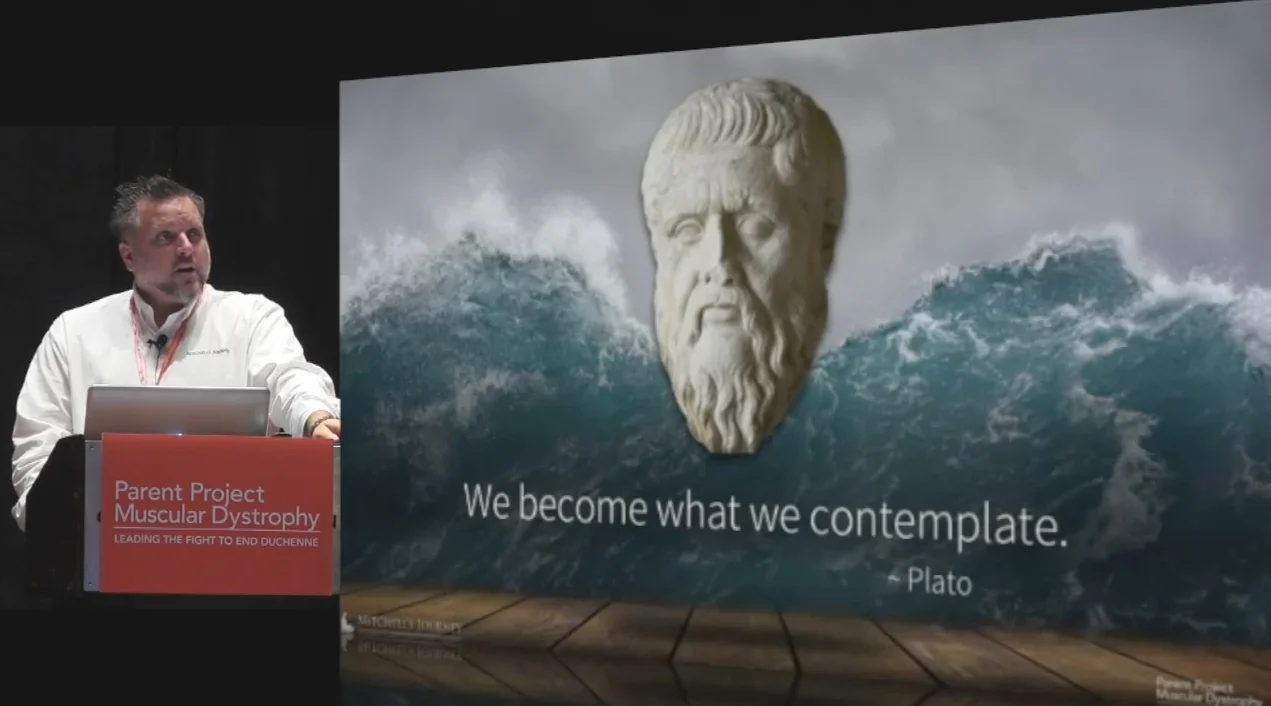
A few weeks ago, I was honored to speak at the 2017 PPMD conference. In this short address, I shared a tender story about Mitch and the ocean and what I learned about responding to things we can't control. I also shared other sweet experiences that remind me to treasure each moment and take special care of ourselves, our community and our children.

The rest of the conference was dedicated to science, therapy, clinical trials, and other important issues. But for this brief moment, we set science aside and talked about the things we treasure most - how to care for the ones we love, including ourselves.

If you enjoy little stories of Mitch, there are some tiny gems in this keynote. I hope something here blesses your life in some way.